
Feb 8, 2023 (brought across from Flashcut reviews)
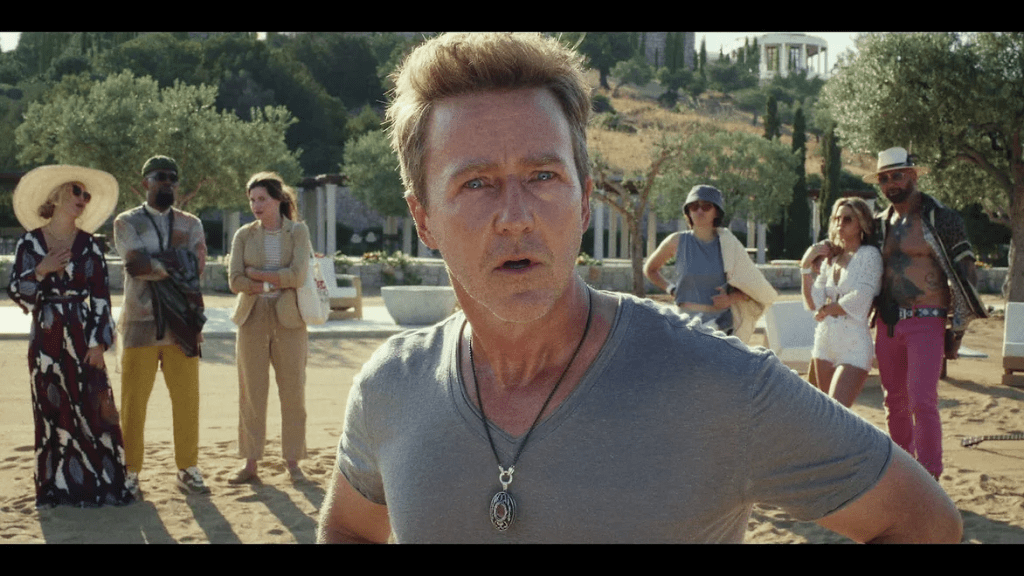
‘It’s a dangerous thing to mistake speaking without thought with speaking the truth’ – Benoit Blanc, Glass Onion.
Be warned: This review enters strong spoiler territory
Five unlikely individuals are invited to their friend’s island for a murder mystery game. How did this bunch of misfits become friends? And why are they so loyal to the man who has invited them?
Within Glass Onion, there is plenty of social commentary to go around, beginning with tackling the prevalent culture (especially on social media) of ‘I’m just saying what everyone’s thinking’. This approach to living life, this state of being, is brutally scrutinised – a bit like Piers Morgan every time he opens his mouth. For a start, how can you speak for every single person and all the thoughts within their heads? But on another, more poignant level, why does controversy seem to, and why should it amount to the truth for certain people?
‘Saying what everyone’s thinking’ often just translates to stating an opinion as a fact without considering the feelings of those said statement involves. Yes, the truth hurts, but so does speaking without thinking. Blanc is highlighting how easily confused the two have become, and this has never been more correct in today’s society.
As he says, ‘It’s a dangerous thing to mistake speaking without thought with speaking the truth.’ Perhaps this attitude has arisen because of the figureheads who validate going against the grain of genuine respect for others. The singular truth about controversy is that it generates views, and views generate more money for the pockets of those at the top. It’s not about us, really. It has always been about the people who feed off of misery, anger and hatred.
Another thing is that people love to feel validated in their beliefs, because changing them is certainly not as easy as changing clothes. It is more comfortable to stick with what you have grown up with, or want to believe, even if said beliefs or opinions hurt people.
The metaphor of the glass onion itself – something seemingly complicated and layered, yet clear as day – is the driving force of this film. Nowadays, we often assume the truth is complicated – and it is in a lot of (even in the majority of) cases. But don’t let yourself be gaslighted into thinking some things (kindness, openness, generosity and physical and visual FACTS are complex). Grass is green. You could go into complex discussions about what that means, but it is green. Not everything should or needs to be up for debate.
This is represented through the jarring use of glass. As the onion empire all comes shattering down at the end of the film (both literally and symbolically), the layers are peeled back to reveal, in plain sight, the ‘genius’ for what it and he is. Edward Norton’s Miles is a symbol for all I’ve just discussed. He is the controversy machine that exploits and heightens people’s views for personal gain.
An important word that comes up throughout the film is ‘disruption’. The thing is though, the people who call themselves disruptors are often the people who uphold the very systems they claim to be dismantling.
Claire the politician (Kathryn Hahn) Dave Bautista (as the film’s misogynist), Kate Hudson (the one who ‘says what’s on her mind’), Leslie Odom Jr. (the scientist) and all of the rest of them are clinging on to a system that mimics the worst parts of our very own society. They are disrupting nothing, merely upholding a worldview that has existed for centuries.
True disruption is standing up for the actual truth – not going along with a singular person’s version of it. And disruptors don’t call themselves that because they know that change doesn’t happen overnight.
Real geniuses are thought leaders, changing the conversation; because yes, ‘disruptors’ don’t like to have conversations. They don’t like to be challenged. They believe their worldview must be the correct worldview. But we should all be critical, particularly in this age of disinformation and clickbait. We must know that one person’s opinion is unlikely to be the full onion, as it were.
Another cleverly utilised narrative technique within Glass Onion is Rian Johnson’s use of flashbacks, splitting the narrative into shards of the past and present. Seeing who we presume is Andi (outcast from the group due to Miles’s interference) get shot is genuinely shocking. Then we’re whisked off back into the past, where she (actually Andi’s sister, Helen) meets Blanc and undertakes the mission of pretending to be her deceased sister to get some kind of revenge. The use of this filmmaking technique is intelligent. You get to experience the thoughts of someone you believe is dead. It disrupts – hehe – the direction of the movie, but in a refreshingly unexpected way.
There are even moments that evoke biblical stories, especially near the end, where the killer asks everyone whether they saw his confession, but they all turn away and deny the truth. These techniques help give the film some true depth and add character dimensions, but the ending is too rushed – at least in my opinion.
The resolution of the character arcs of those who side with Miles initially is far too quick. The realisations that they come to over how much they’ve hurt others is glossed over too quickly. Whilst they are set up as complex characters, the film doesn’t quite follow through on tying everything together. The third act, failing to come to a satisfying resolution is really what lets the film down.
Ultimately, at the centre of the glass onion, as Blanc says, is something stupidly obvious. Sometimes the people we look up to as geniuses put on a front of genius – but we don’t actually know all that went into that image. Sometimes a certain image comes from hard work, but other times, it is simply a façade.
It’s difficult to find that perfect balance between simplicity and complexity. We must account for the fact that people are complex, but sometimes, their actions aren’t.
Let’s try our best to not mistake real onions for glass ones. But they have one thing in common – when broken, they’ll both make you cry.
Verdict: Not quite as good as the first movie, but full of social commentary that will leave many people pondering on what it means to be a real force of change.
8/10

 Ninth Dimension Copy
Leave a comment